Farming with nature
Farming shapes over 70% of the UK’s land, meaning the future of nature is inextricably linked with the future of agriculture. How we choose to farm – how we grow food, improve soils, manage water, and shape the landscape – has a profound impact on biodiversity.
That’s why nature friendly farming matters. It isn’t about choosing between food production and biodiversity – it’s about recognising that the two can, and must, thrive together. At Earth Trust, our farm demonstrates that when farmers work with natural systems, productivity and biodiversity can both flourish. Funded by the Species Survival Fund, a partnership between Defra and The National Lottery Heritage Fund, our recent nature-friendly farming developments are part of the £1.5 million Partnerships for Nature initiative led by the North Wessex Downs National Landscape. Our work showcases the potential for combining traditional farming wisdom with innovative ecological practices to halt and reverse the decline in species abundance. We’re illustrating what this future looks like: flower-rich pastures buzzing with life, hedgerows and orchards stitched back into the landscape, and fields that produce food while giving space for nature to thrive.
What’s changed?
- Creating 8 hectares of new flower-rich pasture and 1.5 hectares of wildflower infield margins
- Planting 88 meters of species-rich hedgerows, 1 kilometre of fruit tree lines, and 400 native in-field trees in nearby fields
Flowering meadows and margins:
Across our farm, we’ve created wildflower strips along field edges to provide flower-rich habitat for insects that pollinate crops and help control pests naturally. These colourful margins support bees, butterflies, hoverflies, bumblebees, ladybirds and ground beetles, boosting biodiversity and improving crop health. These deep-rooted plants also strengthen soil structure and reduce erosion. In summer the strips buzz with life, while in autumn and winter they offer vital shelter and food, helping wildlife thrive year-round.
Chalk meadow
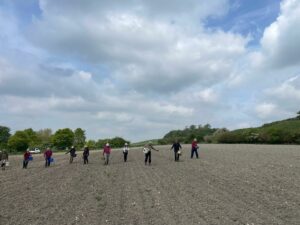
As part of the project we have sown a 10 hectare (24 acre) area to create a flower-rich rare chalk meadow. Seed collected from ancient, species-rich Cotswold chalk grasslands was supplied and sown with support from partners at Cotswolds National Landscape. Alongside restoring valuable habitat, the project also revives the historic open landscape around Castle Hill, reconnecting people with a setting shaped by centuries of coexistence between nature and communities.
Trees within crops
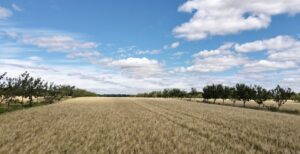
We have transformed a conventionally farmed arable field – now planted with six metre wildflower strips, with fruit and nut trees spaced throughout. The remaining land is still actively farmed with rotated arable crops. Making space for wildflowers supports biodiversity, encouraging pollinators like bees and beneficial insects such as ladybirds who help manage outbreaks of pests.
The apple, pear, plum and nut trees diversify income while improving crop resilience through better soil health and helping hold carbon in the soil.
Trees in grazed fields
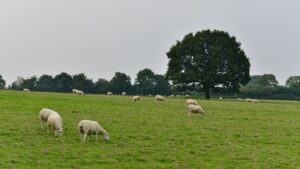
One of our grazing fields has been planted with trees, including oak, field maple, lime and disease resistant elm, each protected by stockproof enclosures.
Adding trees to pasture benefits livestock and wildlife: as they mature, they’ll provide vital shade and shelter, reducing heat stress in a changing climate. The trees will become habitats for birds and insects, encouraging natural pollination and pest control
The field has also been over-sown with a diverse herbal mix to improve soil health, support pollinators and enhance grazing.
Simon Atkinson, Earth Trust’s Director of Land Management, said:
“This is regenerative farming in action—working with nature, not against it. By planting trees, wildflowers, and hedgerows, we’re creating healthier soils, more wildlife, and food for people. It’s about showing that farming can be productive and good for the environment at the same time.”
Partnerships for Nature
The habitat improvements in our two fields are part of the Partnerships for Nature programme which is led and administered by the North Wessex Downs National Landscape Partnership (NWDNL). The NWDNL published a Nature Recovery Plan identifying priorities to restore nature in the protected landscape. Our fields are one of seven sites where conservation effort is focussed, kick-starting delivery against this plan.
The Partnerships for Nature programme, and the habitat improvements in our two fields, are funded by the Government’s Species Survival Fund. The fund was developed by DEFRA and its Arm’s-Length Bodies. It is being delivered by The National Lottery Heritage Fund in partnership with Natural England and the Environment Agency.
We are very grateful for the support from our funders.
